







- Site Navigation -
NEWS LIST
How to Choose the Right Scaffold Fittings for Your Project
Author:yicheng Date:2026-05-02 14:47:04 Hits:145
Selecting appropriate scaffold fittings is a vital step in guaranteeing safety, operational efficiency, and structural stability at any construction site. Whether your work involves residential buildings, commercial skyscrapers, or industrial facilities, the right choice of fittings directly influences the safety and adaptability of your scaffolding system, exerting a decisive impact on the entire construction process. This guide outlines the core factors that should be carefully considered when choosing scaffold fittings for your specific project.
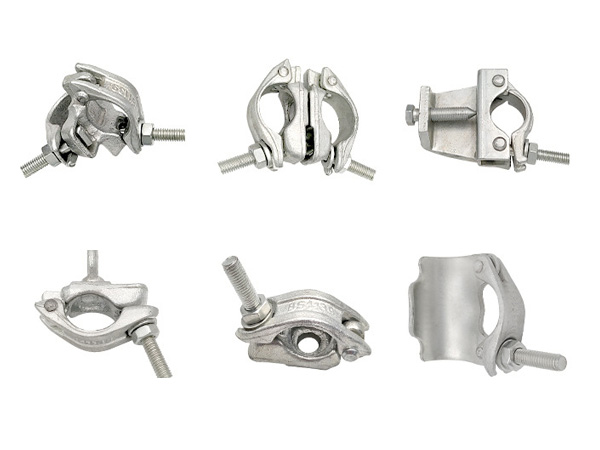
1. Clarify Your Project Requirements
Prior to selecting any scaffold fittings, it is essential to gain a clear understanding of your project’s overall scope and specific needs. Start by addressing the following key questions:
What is the height of the building structure?
What kind of work will be carried out (e.g., painting, masonry, maintenance, installation)?
How long is the scaffolding expected to be in use?
Will the structure feature complex shapes or straight lines?
For simple structures, standard fittings may be sufficient to meet the requirements. However, for complex or irregular buildings, more flexible systems—such as tube-and-coupler scaffolding—are often necessary to adapt to the unique structure.
2. Select the Appropriate Type of Scaffold Fittings
Different scaffold fittings serve distinct structural functions, so choosing the correct type is fundamental to ensuring the stability of the scaffolding system.
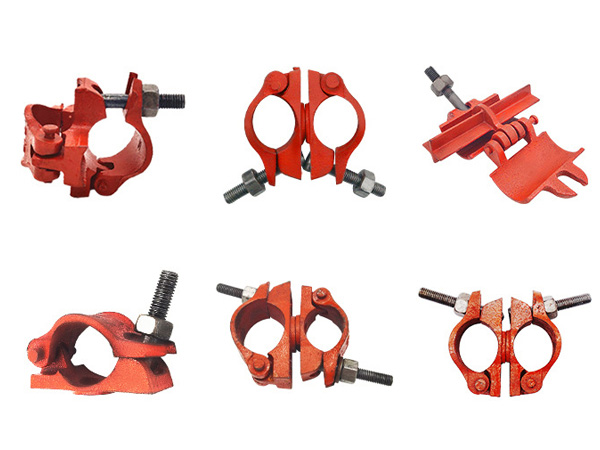
Couplers (Clamps)
Couplers are the most critical fittings in any scaffolding system, playing a key role in connecting tubes throughout the entire structure.
Right-angle couplers: Used to connect two tubes at a 90-degree vertical angle
Swivel couplers: Allow for rotational adjustment, enabling angled connections between tubes
Sleeve couplers: Designed to extend the length of tubes by connecting them in a straight line
Putlog couplers: Provide support for scaffold boards and transoms, ensuring the stability of the working platform
If your project involves complex geometric structures, swivel couplers offer greater flexibility, making it easier to adapt to the installation needs of irregular parts.
Base Plates and Adjustable Jacks
These fittings are primarily used to ensure the stability of the scaffolding’s base, serving as the foundation for overall scaffolding safety.
Base plates are suitable for firm, level ground conditions
Adjustable jacks should be used on uneven surfaces to adjust the height and ensure the scaffolding remains level
They effectively distribute the overall load of the scaffolding, preventing ground settlement caused by concentrated loads and ensuring the base of the scaffolding remains stable.
Joint Pins and Spigots
These fittings are specifically designed for vertical tube connections and are core components for building multi-level scaffolding.
Ideal for vertical splicing of multi-level scaffolding
Ensure accurate alignment between upper and lower tube sections, guaranteeing structural stability in the vertical direction
For high-rise building scaffolding, joint pins and spigots are indispensable key fittings that directly affect the overall load-bearing capacity of the scaffolding.
Board Retaining Clips
These fittings are used to secure scaffold boards in place, preventing them from sliding or shifting during construction work and fundamentally ensuring the safety of workers operating at height.
3. Prioritize Material Quality
The quality of the materials used in scaffold fittings directly relates to the safety and service life of the scaffolding, making it a core factor that cannot be ignored during the selection process. Common materials for fittings include:
Forged steel: High in strength and toughness, suitable for heavy-load, high-strength construction scenarios
Pressed steel: Lightweight and cost-effective, ideal for general-strength routine construction needs
Galvanized steel: Possesses excellent corrosion resistance, making it suitable for outdoor construction or long-term projects
For projects in outdoor, humid, or other corrosion-prone environments, it is strongly recommended to use hot-dip galvanized scaffold fittings, which can effectively extend the service life of the fittings and reduce maintenance costs.
4. Verify Load Capacity and Safety Standards
Every scaffold fitting has a specific load-bearing limit and must strictly meet the load requirements of the project, which is the bottom line for ensuring construction safety. When selecting fittings, pay attention to the following points:
Carefully check the load rating provided by the manufacturer to ensure it meets the actual load needs of the project
Ensure the fittings comply with internationally recognized standards (such as EN standards, OSHA standards, etc.) and have corresponding safety certifications
Never mix incompatible or uncertified fittings, as this can lead to structural hazards
Using substandard or non-compliant fittings can easily cause scaffolding structural collapse, resulting in serious safety accidents and property losses.
5. Ensure Compatibility with the Scaffolding System
Different types of scaffolding systems require matching fitting models and specifications, and not all fittings are universally compatible. Common scaffolding systems include:
Tube and coupler scaffolding
Ringlock scaffolding
Cuplock scaffolding
Frame scaffolding
When selecting fittings, confirm that they are fully compatible with the type of scaffolding system used in the project to avoid installation difficulties, structural instability, and other potential hazards.
6. Consider Environmental Factors
Differences in construction environments can directly affect the performance and service life of scaffold fittings, so the selection should be tailored to the on-site environment.
Coastal areas: High salt content in the environment requires galvanized steel fittings with strong corrosion resistance
Cold regions: Low temperatures demand materials with good impact resistance to avoid low-temperature brittleness
High-humidity environments: Prone to rust, requiring fittings with anti-rust treatment
Heavy industrial areas: High loads and complex environments require stronger forged steel fittings
Choosing materials and coating treatments suitable for the environment can effectively extend the service life of the fittings and reduce long-term maintenance costs.
7. Evaluate Ease of Installation
Operational efficiency is crucial at construction sites, and the ease of installation of fittings directly affects construction progress and labor costs.
Swivel couplers are flexible to adjust, significantly saving time on connection and adjustment
Pre-assembled fittings can be installed directly, reducing on-site assembly processes and shortening the construction period
Standardized size fittings have strong versatility, facilitating installation and later replacement
Selecting easily installable scaffold fittings not only significantly reduces labor costs but also minimizes construction delays caused by cumbersome installation.
8. Collaborate with a Reliable Supplier
A reliable supplier is key to ensuring the quality and supply stability of scaffold fittings, directly affecting the smooth progress of the project. When choosing a supplier, focus on the following aspects:
Possess relevant quality certifications (such as ISO certification, CE certification, etc.) to ensure product quality meets standards
Able to provide load test reports for the fittings to prove compliance with safety standards
Maintain stable production standards to ensure consistent product quality
Offer professional technical support and complete product documentation to facilitate construction guidance
Have stable supply capacity to meet the needs of large-scale projects and avoid supply interruptions
Collaborating with a reliable supplier can effectively reduce the risk of substandard fittings and provide guarantee for the long-term smooth progress of the project.
Conclusion
Selecting the right scaffold fittings is not merely a purchasing decision but a critical engineering choice related to construction safety. By clarifying project requirements, selecting appropriate fitting types, prioritizing material quality, and strictly adhering to safety standards, a stable and efficient scaffolding system can be constructed. High-quality scaffold fittings not only improve construction efficiency and reduce safety risks but also ensure that workers can carry out their tasks safely and smoothly at any height, laying a solid foundation for the safe progress of the entire construction project.
References
GB/T 7714:Specification for Structural Steel Buildings. American Institute of Steel Construction, Chicago.
MLA: Optimization design of large span portal-rigid steel frame with tapered sections under wind-induced drift constraint. Engineering Structures
APA: The application and research progress of steel structures in construction industrialization. IOP Conference Series: Earth and Environmental Science

Contact Us
Tel:+86-15831733891
E-mail:yichengbuildingmaterials@gmail.com
Add:100 meters south of Weicun Village, Hechengjie Town, Xian County, Cangzhou City, Hebei Province
Url:https://www.yc-buildingmaterials.com